America's Worst States for Contractor Scams: The 2026 Risk Index
Hiring a contractor is one of the biggest financial decisions many homeowners make, but it can also come with serious risks. From unfinished jobs to fake credentials and hidden costs, contractor scams continue to affect homeowners across the country. To better understand where these problems are most common, we analyzed BBB Scam Tracker reports, Google search trends, and survey responses from more than 1,000 homeowners nationwide.
The findings revealed major differences in scam activity from state to state, along with widespread confusion about contractor licensing, bonding, and vetting practices. As inflation and rising repair costs pressure homeowners to make faster decisions, many are skipping important background checks that could help protect them from fraud.
Key Takeaways
- Washington ranks as the No. 1 worst (highest-risk) state in the U.S for contractor scams.
- Iowa ranks as the No. 1 best (lowest-risk) state in the U.S. for contractor scams.
- 41% of American homeowners say they rarely or never verify a contractor's state license before hiring them.
- 28% of homeowners have been scammed or ripped off by a contractor. The average loss when homeowners get burned is $2,278.
- 38% of homeowners wrongly assume that a contractor with a license is automatically bonded and insured.
- 23% of homeowners say they've hired a contractor on social media without doing any background check first.
America's Worst States for Contractor Scams
Contractor fraud risks looked very different depending on where homeowners lived. Some states saw much higher levels of scam reports, financial losses, and online searches related to contractor disputes and fraud concerns.
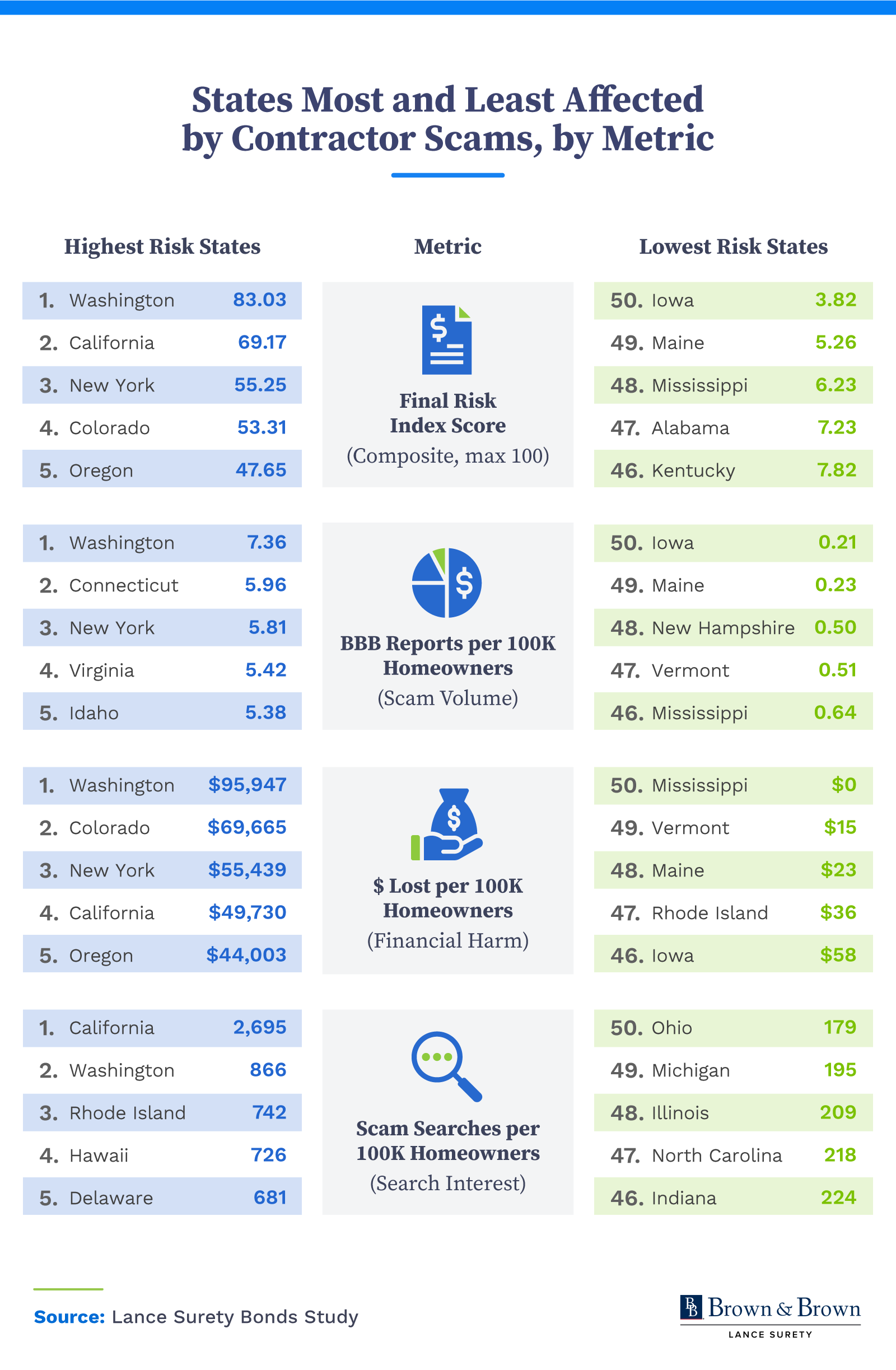
Washington ranked as the worst state in the country for contractor scams in 2026 based on scam volume, financial harm, and contractor-fraud search activity. The state consistently showed high levels of reported scam activity, helping it earn the highest overall risk score in the study. Iowa ranked as the safest state overall, reporting the lowest level of contractor scam risk among all 50 states analyzed.
At the city level, Dallas, Texas, recorded the highest number of BBB Home Improvement scam reports between January 2024 and April 2026, with 54 complaints filed and a median loss of $784 per scam. Los Angeles followed closely behind with 50 reports and a median loss of $1,151, while St. Louis reported 49 scams with one of the highest median losses at $2,500 per incident.
Several cities stood out for especially costly scams. Seattle, Washington, ranked fourth overall for scam reports but had the highest median loss among the top cities at $5,000 per scam. Portland, Oregon, also reported steep financial damage, with a median loss of $3,100. These larger losses may point to homeowners taking on major renovation projects with fraudulent or unlicensed contractors.
Other cities appearing in the top 10 included Philadelphia, Denver, New York City, Rochester, and Charlotte. While some cities reported lower median losses, the volume of complaints highlighted how widespread contractor fraud concerns have become across both large and mid-sized housing markets.
Why Many Homeowners Skip Contractor Background Checks
Many homeowners admitted they were not taking basic precautions before hiring contractors. Financial pressure, confusion about licensing rules, and reliance on social media all appeared to influence hiring decisions.
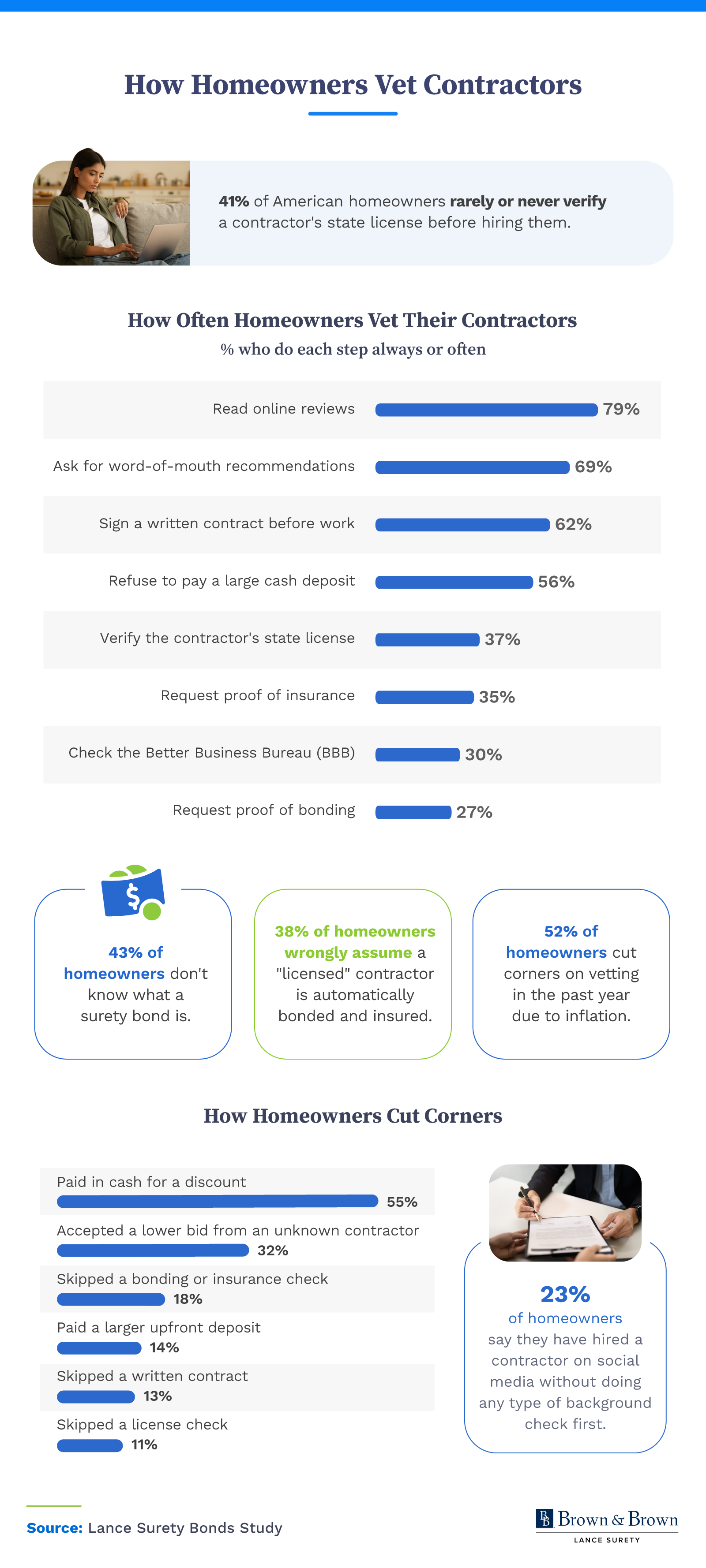
A concerning 41% of homeowners said they rarely or never verified a contractor's state license before hiring them. Only 49% said they knew how to verify a contractor's license in their state, suggesting that many consumers may not fully understand the process or know where to start.
Some states showed much stronger verification habits than others. South Carolina, Massachusetts, and Indiana tied for the highest contractor license verification rate at 57%, followed by Illinois at 55% and Pennsylvania at 50%. Homeowners in these states appeared more likely to take extra steps before hiring someone to work on their property.
Confusion around licensing and bonding also remained common. More than one-third of homeowners (38%) wrongly assumed that a licensed contractor is automatically bonded and insured. Gen Z homeowners were the most likely to believe this myth at 51%, followed by millennials at 42%. In reality, licensing, bonding, and insurance are separate requirements that can vary by state and contractor type.
Inflation and rising repair costs also influenced hiring behavior. More than half of homeowners (52%) said they cut at least one corner on contractor vetting during the past year because of financial pressures. Gen Z homeowners were the most likely to admit doing so at 67%, followed by millennials at 55%.
Social media played a growing role in contractor hiring decisions as well. Nearly one-quarter of homeowners (23%) said they hired a contractor through a social media advertisement without conducting any background check first. Gen X homeowners reported the highest rate of this behavior at 27%, while Gen Z and millennials were tied at 21%.
The Real Financial Cost of Contractor Scams
Contractor scams created frustration for homeowners, but they also caused major financial losses. Many homeowners who experienced fraud admitted they skipped important verification steps beforehand.
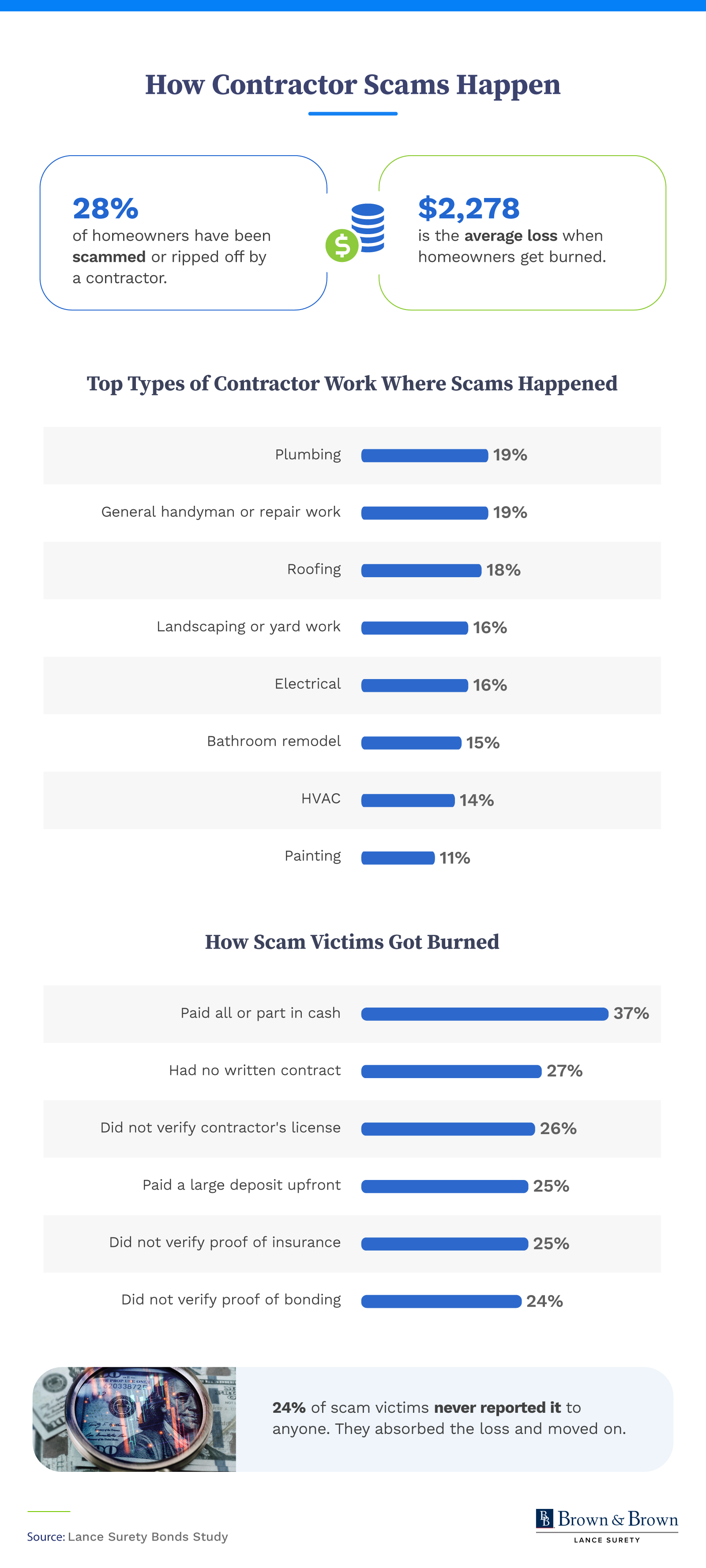
More than one in four homeowners (28%) said they had been scammed or ripped off by a contractor. On average, homeowners who experienced fraud lost $2,278. These losses likely included unfinished work, low-quality repairs, hidden charges, or contractors disappearing after receiving payment.
Baby boomers reported the highest scam rate among all generations at 33%, followed closely by Gen X at 32%. Gen Z homeowners reported a 30% scam rate, while millennials reported the lowest rate at 25%. Older homeowners may have faced increased exposure due to larger homeownership rates and more frequent renovation projects.
License verification appeared to play an important role in scam prevention. Among homeowners who were scammed, 26% said they did not verify the contractor's license beforehand. Baby boomers were the most likely to skip this step at 38%, while Gen X and millennials were tied at 24%. Gen Z homeowners reported the lowest rate of failing to verify a license at 18%.
The findings suggest that even simple vetting steps could help reduce financial risks. Verifying a contractor's license, confirming bonding status, and checking complaint histories may help homeowners avoid costly mistakes before signing a contract or making an upfront payment.
Protecting Homeowners From Contractor Fraud
Contractor scams continue to affect homeowners across the country, but the risks are not evenly distributed. States like Washington reported especially high levels of scam activity, while cities such as Seattle and St. Louis showed how financially damaging contractor fraud can become. At the same time, many homeowners admitted they were skipping important vetting steps or misunderstanding what contractor licensing actually means.
The study also revealed how inflation and online advertising have changed the way people hire contractors. As more homeowners rush into decisions without verifying licenses, bonding, or insurance, the opportunities for fraudulent contractors continue to grow. Taking a few extra minutes to verify credentials could make the difference between a successful project and a costly scam.
Methodology
To identify the worst states for contractor scam risk in 2026, we scored all 50 states across three factors that measure where homeowners are most actively encountering, reporting, or researching contractor fraud. Each factor was scaled to its weight below, then summed into a final score out of 100. The state that led each factor received the full weight; every other state scaled proportionally.
Scoring Categories and Weights
- Scam Volume — 40 Points
The number of Home Improvement scam reports filed to the Better Business Bureau Scam Tracker per 100,000 owner-occupied housing units in each state, between January 2024 and April 2026. States with more reports per capita have homeowners who are more frequently encountering and reporting fraudulent contractors. Source: BBB Scam Tracker (Home Improvement category); U.S. Census Bureau, American Community Survey 5-Year Estimates
- Financial Harm — 35 Points
Total dollars lost to home-improvement scams reported to the BBB Scam Tracker per 100,000 owner-occupied housing units, between January 2024 and April 2026. States with higher dollar losses per capita have homeowners experiencing the most severe financial damage from contractor fraud. Source: BBB Scam Tracker (Home Improvement category); U.S. Census Bureau, American Community Survey 5-Year Estimates
- Scam Searches — 25 Points
Total monthly search volume across 10 contractor-fraud keywords — contractor scam, shady contractor, bad contractor, fake contractor, contractor fraud, unlicensed contractor, check contractor license, sue contractor, contractor lawsuit, and contractor dispute — per 100,000 owner-occupied housing units, between January 2023 and March 2026. Higher search interest indicates homeowners actively researching contractor fraud, whether trying to avoid scams or recover from them. Source: Google Trends.
City-level rankings (Top 10 Worst Contractor-Scam Cities) use raw BBB Home Improvement complaint counts attributed by the scammer's stated city of operation (BBB's scammer_city field).
We also surveyed 1,003 U.S. homeowners about how they vet contractors before hiring them, what they know about contractor licensing and bonding, whether they've been scammed or overcharged by a contractor, and how rising costs have shaped their vetting habits in the past year. Respondents represented a mix of household incomes, regions, genders, and generations across the country. The generational breakdown was 49% millennials, 33% Gen X, 13% baby boomers, and 6% Gen Z. Data was collected in May of 2026.
About Lance Surety Bonds
Lance Surety Bonds helps contractors, construction professionals, and business owners secure the surety bonds they need to stay compliant and build trust with clients. From contractor license bonds to other industry-specific bond solutions, Lance Surety Bonds makes the bonding process fast, simple, and reliable for professionals across the country.
Fair Use Statement
The information and findings in this article may be shared for noncommercial purposes only. If you reference or republish this content, please provide proper attribution with a link back to Lance Surety Bonds.
Latest posts by Stephanie Martinez (see all)

Get a FREE Surety Bond Quote in Minutes
-
 Fast and Secure Application
 -
 Money Back Guarantee
 -
 Approval in Minutes
 -
 Nationwide Coverage
-
 Fast and Secure Application
 -
 Nationwide Coverage
 -
 Approval in Minutes
 -
 Money Back Guarantee
- Image

- Image

- Image


Lance Surety Bond Associates, Inc. is a surety bond agency based out of southeastern Pennsylvania that is able to write all surety bond types in all 50 states. We are dedicated to servicing all of our customers' surety bonding needs throughout the country and guarantee competitive rates, timely responses, and unparalleled customer service.


