
The Crossover Founder: From Office Jobs to Bonded Trades

The Crossover Founder: How Americans Are Moving From Tech, Corporate, and Office Jobs Into Bonded, Regulated Trades

The contractor across the street used to sell software. The auto dealer down the road spent a decade in corporate finance. A growing share of new business owners in bonded, regulated trades started their careers behind a desk, and they walked away on purpose. To find out what drives that switch, we surveyed 158 U.S. business owners who left a white-collar career to start or co-own a licensed, bonded business in a regulated trade.
We asked what triggered the move, what blindsided them about licensing and bonding, which of their old skills carried over, and whether the money and the meaning made it worth it. What we heard was a story about betting on ownership, and most say the bet has already paid off, even though the paperwork behind it caught many of them by surprise.
Key Takeaways
- 63% of crossover founders say fear of AI replacing their white-collar job played a role in their decision to leave.
- 78% now outearn their old white-collar peak, with an average income climbing from roughly $64K to $101K.
- 73% of crossover founders say they would never go back to an office job, and 88% would recommend the crossover to other white-collar workers.
- Just over half of crossover founders (51%) did not know their industry would require a surety bond before they started.
- Crossover founders spend an average of about $11,900 to legally get started, and 15% say those up-front costs almost stopped the switch.
- 26% walked away from a white-collar job they called well-paid and successful, making the crossover a pull toward ownership rather than an escape from a failing career.
Autonomy, Not a Bigger Paycheck, Drove the Leap
For most crossover founders, the move was about calling their own shots long before it was about the money.
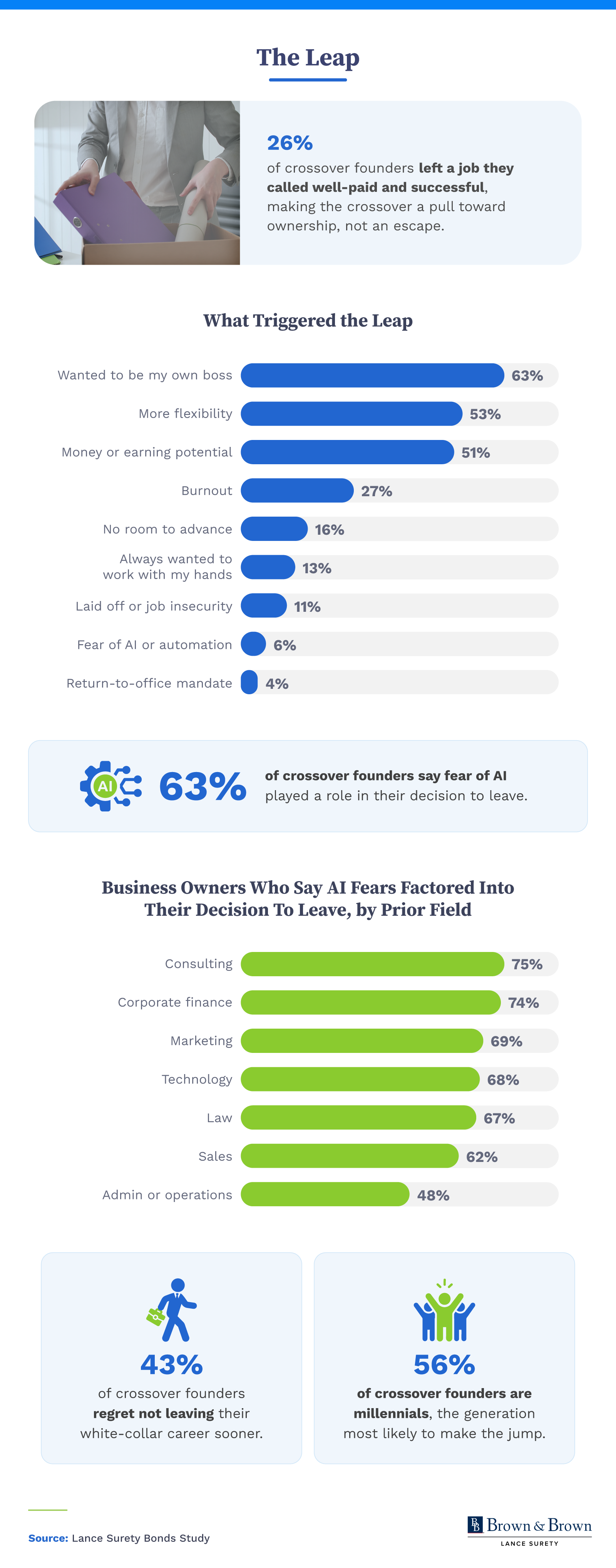
Wanting to be their own boss was the top trigger, named by 63% of crossover founders, ahead of more flexibility (53%) and money or earning potential (51%). Many were leaving on a high note. More than a quarter (26%) left a white-collar job they described as well-paid and successful, and 43% wished they had made the jump sooner. Millennials led the way, making up 56% of the founders we surveyed.
They came from across the white-collar world. Sales was the single most common origin (20%), followed by corporate finance (17%) and technology (16%).
Automation anxiety sat underneath a lot of these decisions. Nearly two-thirds of crossover founders (63%) said fear of AI replacing their white-collar job played a role in leaving, and that share climbed among people who left the fields most exposed to it, including 74% of former corporate finance workers and 68% of former tech workers. That said, only 6% named fear of AI as a top trigger on its own, so the worry tended to reinforce the decision rather than drive it outright.
The Licensing and Bonding Curve Caught Founders off Guard
The trades themselves proved easier to learn than the rules for legally operating in them.
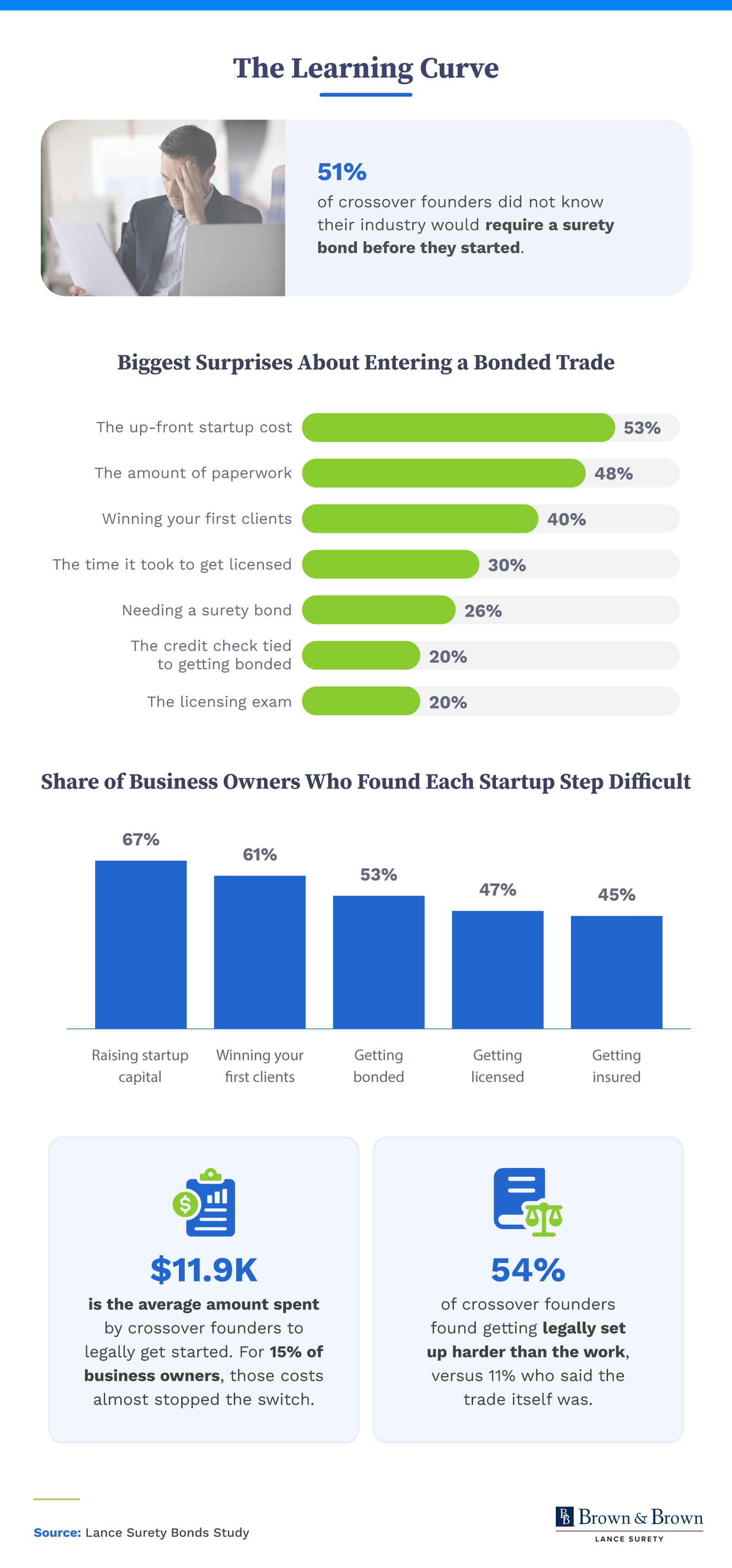
Getting legally and financially set up tripped up far more founders than the actual craft. A majority (54%) said the setup was harder than they expected, compared with just 11% who pointed to learning the trade itself. The single biggest surprise was the up-front startup cost, cited by 53%, followed by the amount of paperwork (48%).
Bonding was a blind spot for many. Just over half of crossover founders (51%) did not know their industry would require a surety bond before they started, and once they got there, 26% were caught off guard by the bond requirement itself and 20% by the credit check tied to getting bonded. The costs added up, too. Founders spent an average of about $11,900 to legally get started, and for 15%, those up-front costs almost stopped the switch entirely.
Their old skills carried over more than many expected. Customer service was the most portable, with 68% saying it helped a lot in the new business. The exception was the paperwork itself, where 22% said their white-collar experience did nothing to prepare them for licensing and bonding.
Most Say the Crossover Already Paid Off
Ask crossover founders whether the risk was worth it, and the answer is a clear yes, in both dollars and day-to-day satisfaction.
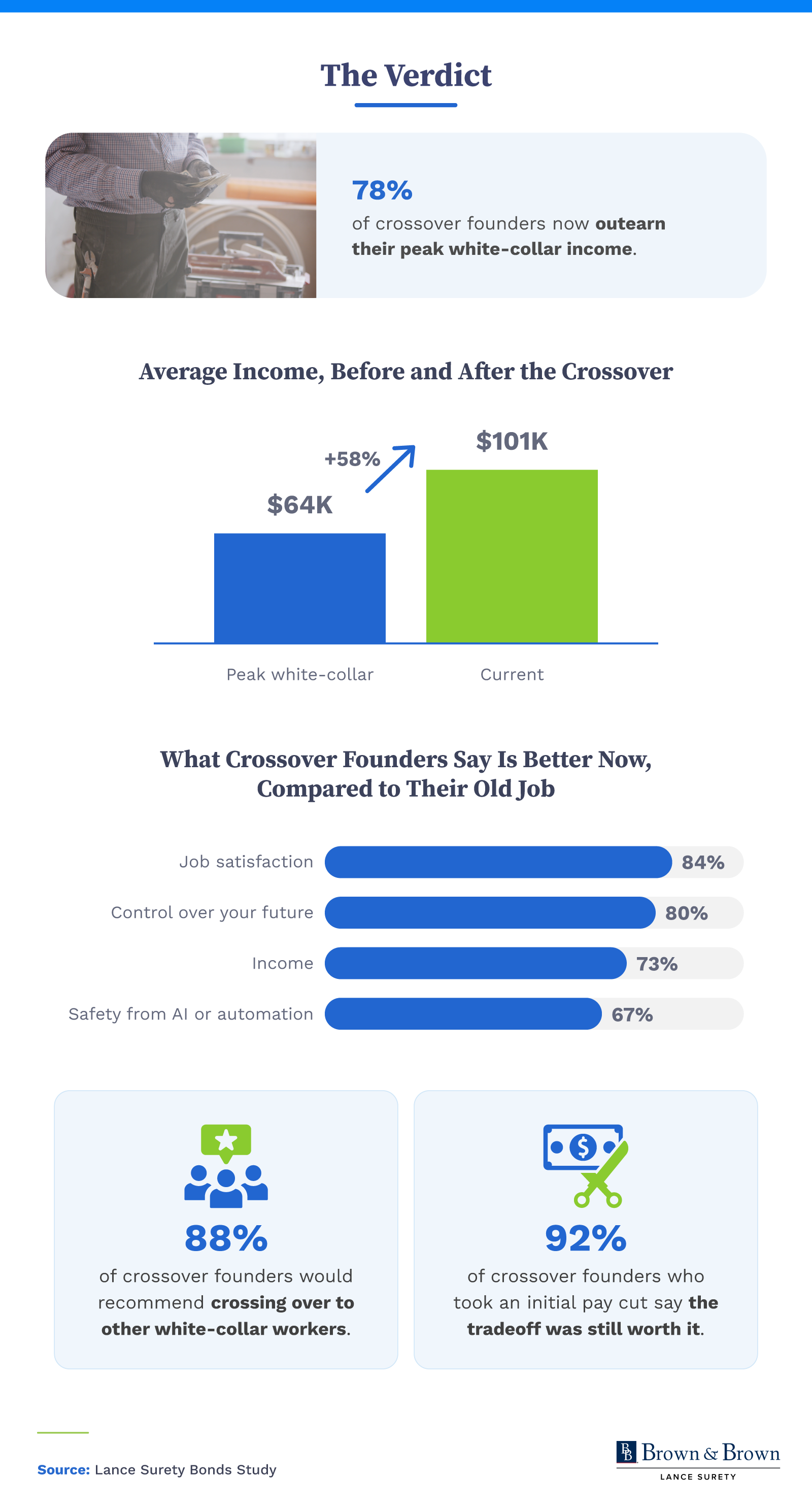
The income story is the headline. More than three-quarters of crossover founders (78%) now outearn their old white-collar peak, with average pay climbing from roughly $64,000 to $101,000, a jump of about 58%. Former corporate finance workers were the likeliest to come out ahead, with 89% out-earning their old peak, compared with 68% of former tech workers. Even among founders who took an initial pay cut to get going, 92% said the tradeoff was still worth it for the control and the long-term upside.
The payoff went well beyond the paycheck. Founders were most likely to say job satisfaction (84%) and control over their future (80%) had improved compared with their old job, and 67% now feel safer from AI and automation than they did behind a desk, a figure that rises to 80% among former tech workers. It adds up to a group with few regrets: 73% said they would never go back to a traditional office job, and 88% would recommend the crossover to other white-collar workers.
The payoff didn't land overnight for everyone. Most got there within a couple of years, with seven in 10 (70%) reaching stability within two years and 19% within the first six months. Even so, 22% came close to giving up and returning to white-collar work before their business found its footing.
What the Crossover Really Takes
The founders in this research make a strong case that leaving a white-collar career for a bonded trade can pay off, in earnings, in autonomy, and in a steadier sense of where the work is headed. The catch is that the hardest part rarely turns out to be the trade itself. If you're weighing a move like this, plan for the licensing exams, the startup costs, and especially the bonding and credit requirements early, because those are the surprises most likely to stall a promising start. Going in with clear eyes on the paperwork is what lets the payoff show up faster.
Methodology
We surveyed 158 U.S. business owners who left a white-collar or office-based career to start or co-own a licensed, bonded business in a regulated trade. Respondents span industries including contracting and construction, real estate, insurance, auto dealerships, freight brokerage, notary services, and mortgage brokerage.
The survey was fielded via CloudResearch Connect and Prolific in July 2026. Respondents ranged in age from 19 to 63, with an average age of 40. The sample was 49% women and 49% men, with the remainder non-binary or preferring not to say. By generation, 56% were millennials, 27% Gen X, 16% Gen Z, and 2% baby boomers.
For questions asking respondents to enter a dollar amount, such as income and up-front startup costs, averages were calculated after removing statistical outliers using the interquartile range (IQR) method. Percentages are rounded to the nearest whole number and may not always sum to 100.
The data and findings reflect self-reported responses. While steps were taken to ensure a quality sample, self-reported data carries limitations, including memory recall and the honesty of respondents.
About Lance Surety Bonds
We help business owners across regulated industries get licensed and bonded quickly, from Contractor License Bonds and Auto Dealer Bonds to Mortgage Broker Bonds and Freight Broker Bonds. For many of the founders in this study, that bonding step was the surprise that stood between them and their first day in business. Learn more about how Lance Surety Bonds supports new business owners entering bonded, regulated trades.
Fair Use Statement
Feel free to share these findings for any noncommercial purpose. We only ask that you link back to this page so readers can view the full study and that Lance Surety Bonds receives proper credit.
Latest posts by Stephanie Martinez (see all)

Get a FREE Surety Bond Quote in Minutes
-
 Fast and Secure Application
 -
 Money Back Guarantee
 -
 Approval in Minutes
 -
 Nationwide Coverage
-
 Fast and Secure Application
 -
 Nationwide Coverage
 -
 Approval in Minutes
 -
 Money Back Guarantee
- Image

- Image

- Image


Lance Surety Bond Associates, Inc. is a surety bond agency based out of southeastern Pennsylvania that is able to write all surety bond types in all 50 states. We are dedicated to servicing all of our customers' surety bonding needs throughout the country and guarantee competitive rates, timely responses, and unparalleled customer service.


