The Cost of Winning Work: What Small Businesses Spend to Compete
The Cost of Winning Work: What Small Businesses Spend to Compete

Long before a small business signs a contract, it has usually paid for the chance to compete. Estimates have to be priced out, permits pulled, and insurance and bonding requirements met, often on nights and weekends. For nearly half of the businesses we surveyed (49%), chasing new work also pulled time away from the customers they already had.
To put a number on that hidden cost, Lance Surety Bonds surveyed 550 people who work at small businesses, including 248 owners, about the time and money they put into pursuing contracts before learning whether they'd won. Their answers show where the money and hours go, why so many businesses pass on opportunities, and how often owners cover the gap themselves.
Key Takeaways
- Most small business owners (84%) have used personal funds to cover the upfront costs of competing for a contract. Among them, the most they've put toward a single contract averages $2,660.
- The average small business spends $1,848 pursuing a single contract before earning a dollar of revenue from it.
- 9 in 10 small businesses spent money in the past year pursuing contracts they never won, an average of $5,884 per business.
- Small businesses put an average of 21 staff hours into competing for a single bid.
- Small business owners give up an average of 11 unpaid nights and weekend days a year chasing bids.
- One in 10 small business owners (10%) spent more in the past year chasing lost contracts than they earned from the ones they won, and another 21% spent about as much as they earned.
A $1,848 Down Payment on Work That May Never Come
Competing for a contract costs real money, and most of it is spent before anyone knows whether the bid will land.
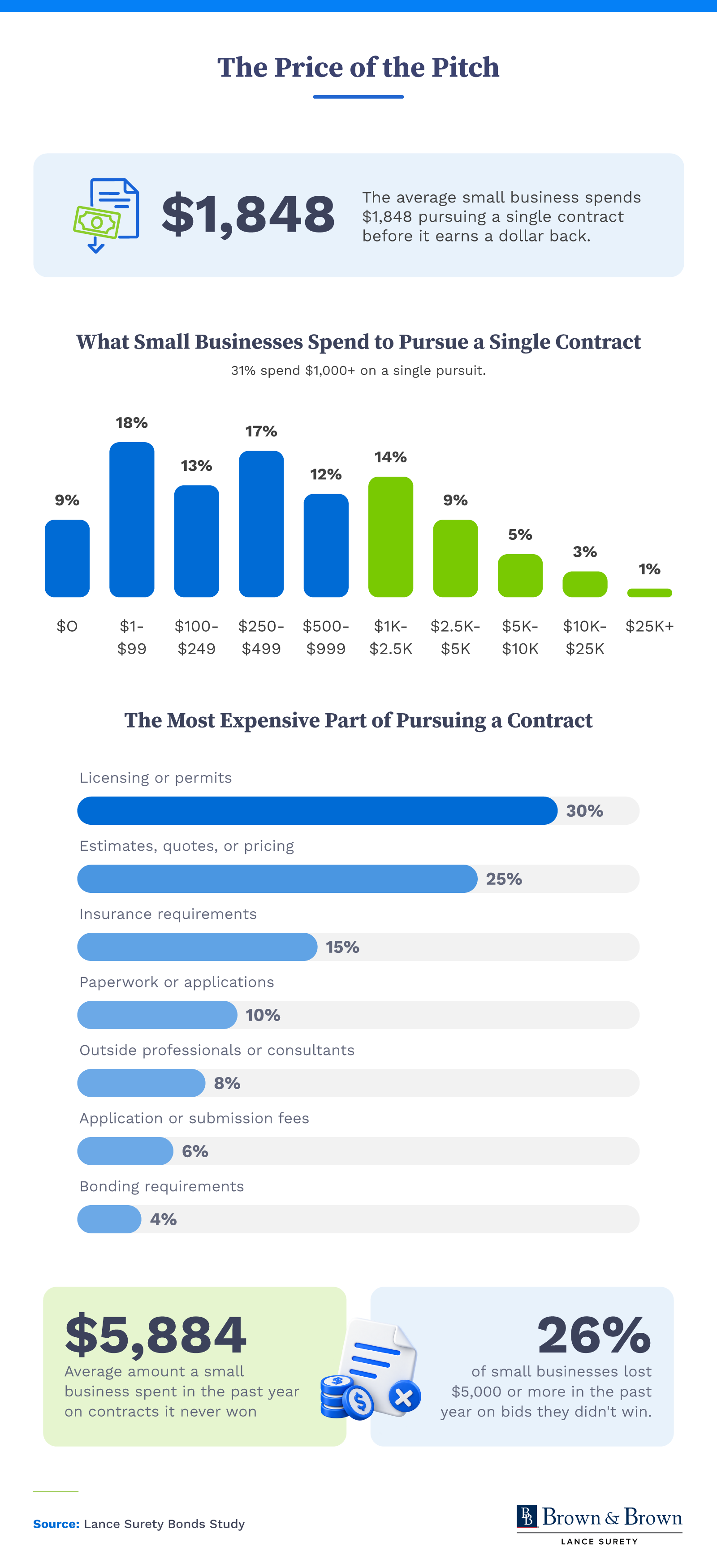
The average small business spent $1,848 pursuing a single contract before earning any revenue from it, and nearly 1 in 3 (31%) spent $1,000 or more on one pursuit. Licensing and permits topped the list of biggest upfront costs (30%), followed by preparing estimates, quotes, or pricing (25%) and meeting insurance requirements (15%). Bonding requirements came in last, named by just 4% as their single biggest expense.
Those costs pile up when bids don't pan out. Nine in 10 small businesses (90%) spent money in the past year on contracts they ultimately didn't win, averaging $5,884 per business. More than a quarter (26%) lost $5,000 or more on unsuccessful bids, and 13% lost $10,000 or more.
More Than Two Workdays Spent Before the Job Even Starts
Money is only part of the price, since every pursuit also pulls hours away from paid work.
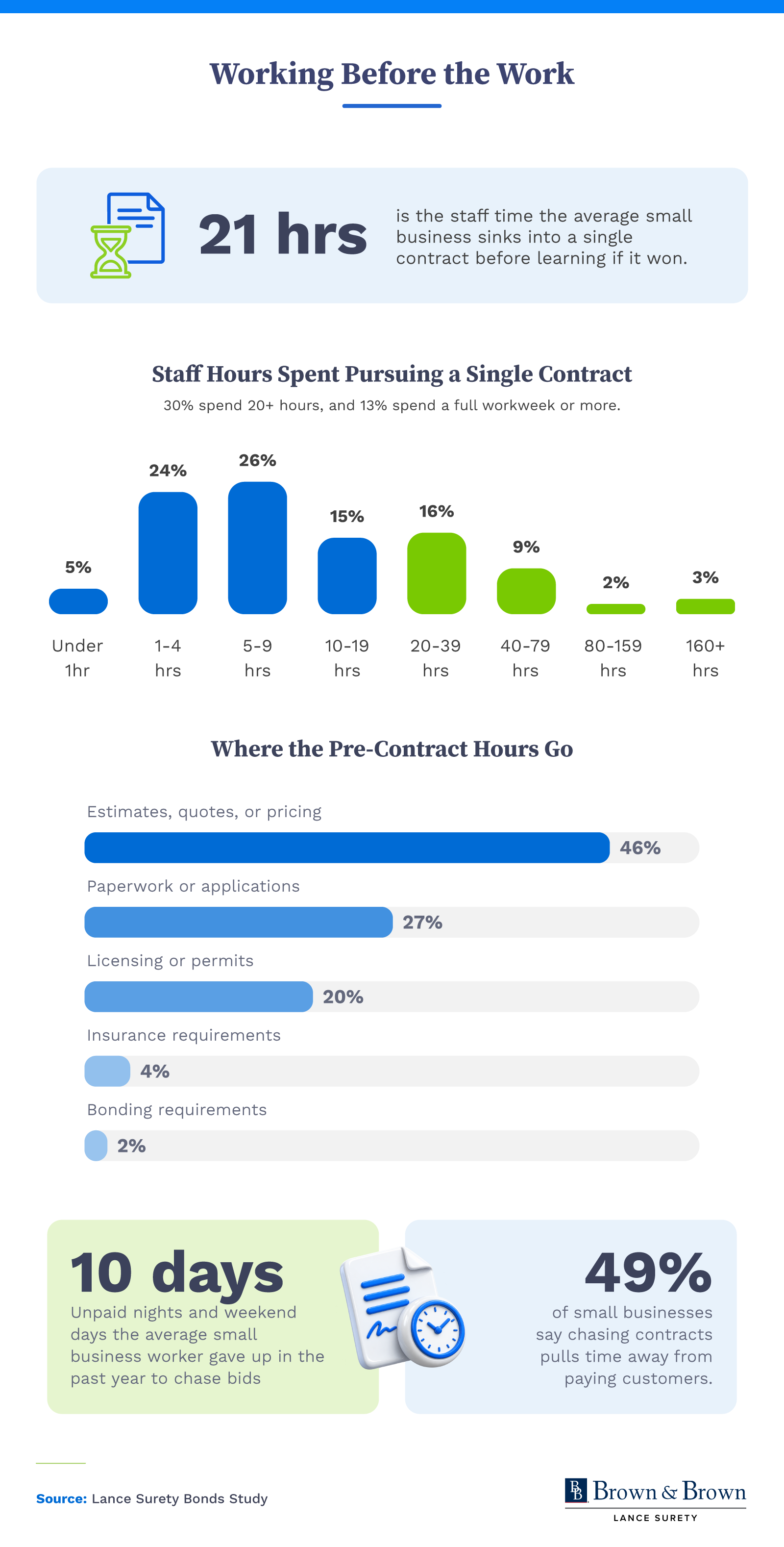
Small businesses put an average of 21 staff hours into pursuing a single contract. Employees reported a heavier load than owners did (25 hours vs. 17), and 35% of employees logged 20 or more hours on one pursuit, compared with 23% of owners. Across all businesses, 30% spent 20 hours or more, and 13% spent a full workweek or longer.
Preparing estimates, quotes, or pricing ate up more time than any other step, named by 46% as their biggest time sink. Paperwork and applications (27%) and licensing or permits (20%) followed well behind.
Much of that effort spilled past business hours. The average small business worker gave up 10 unpaid nights and weekend days in the past year chasing bids, and 13% gave up 21 or more. Nearly half (49%) said pursuing new contracts took time away from existing customers or other revenue-generating work.
When Small Businesses Decide the Chase Isn't Worth It
For many small businesses, the price of competing was high enough to make them pass on work altogether.
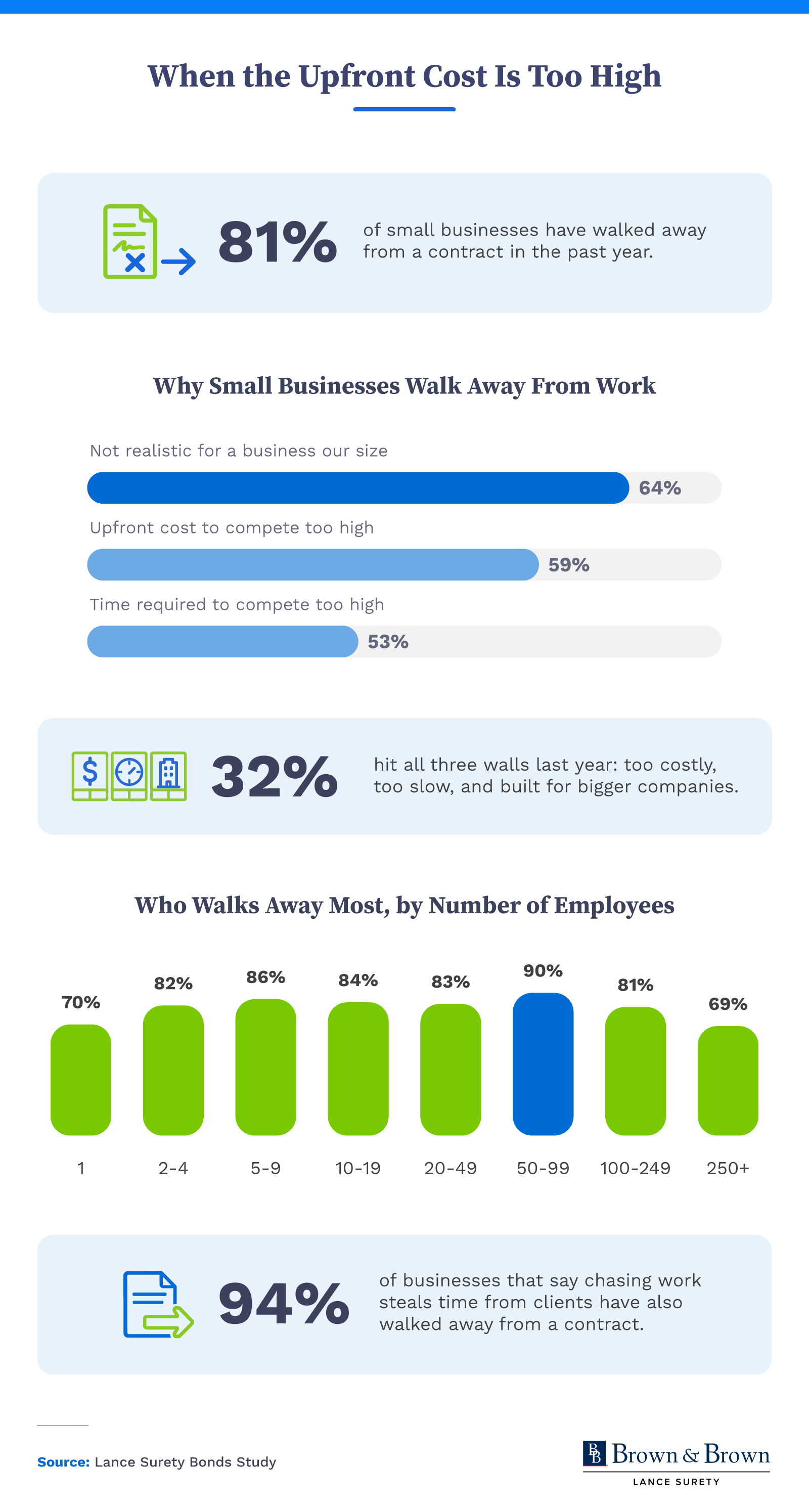
Roughly 4 in 5 small businesses (81%) walked away from at least one contract opportunity in the past year. Size was the most common reason, with 64% saying an opportunity wasn't realistically accessible to a business like theirs. Another 59% said the upfront cost to compete was too high, and 53% said the same about the time required. Many ran into more than one barrier, as 63% cited at least two reasons and 32% cited all three.
Businesses with 50 to 99 employees walked away most often (90%), compared with 70% of one-person operations and 69% of businesses with 250 or more employees. Stepping back didn't spare them from losses, either. Businesses that walked away still spent an average of $6,270 on losing bids, compared with $3,966 for those that never did, and they were nearly four times as likely to say the chase cut into time with clients (56% vs. 15%).
Owners Who Bet Their Own Money on the Next Contract
When the upfront costs came due, owners often covered them personally.
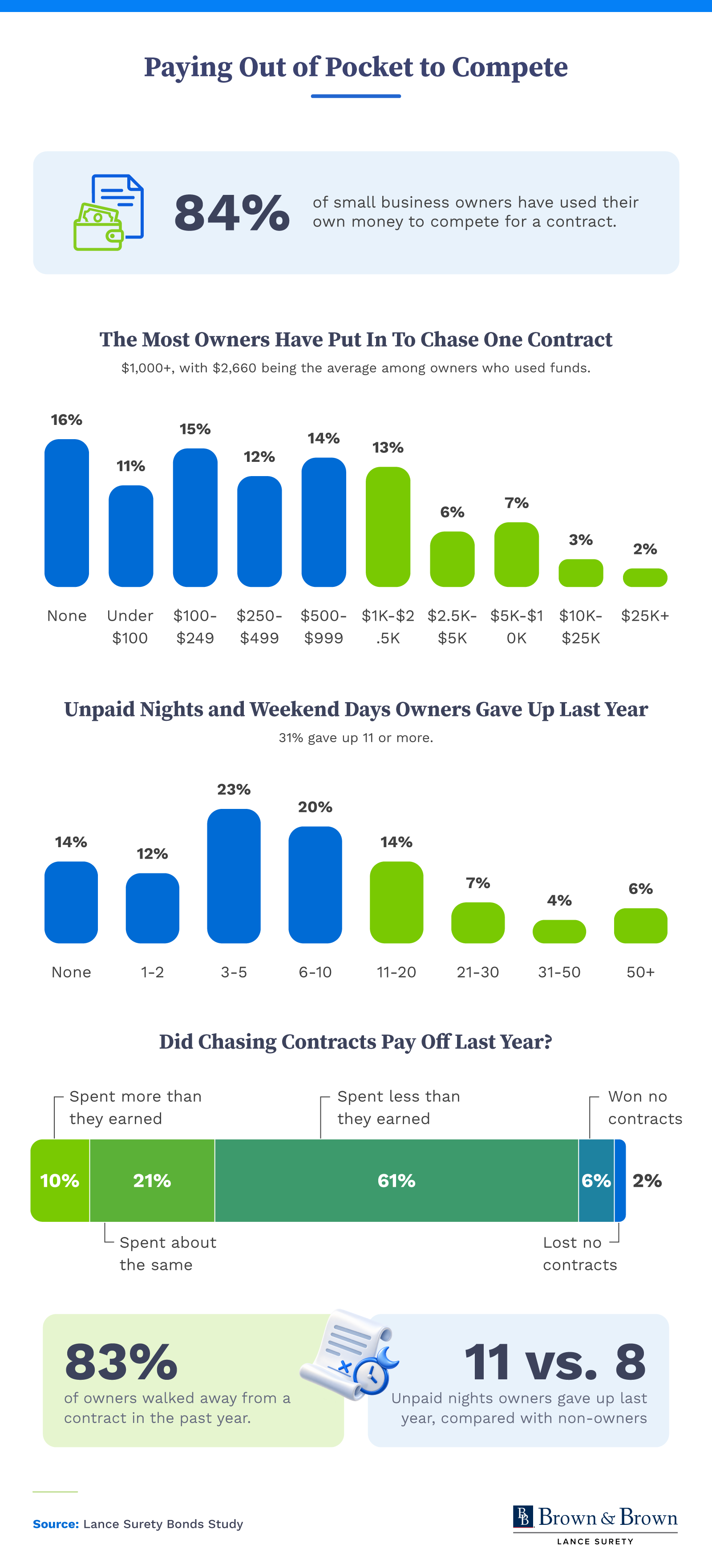
Most small business owners (84%) have used personal funds to compete for a contract. Among those who have, the largest amount they put toward a single contract averaged $2,660. Nearly 1 in 3 owners (31%) have put in $1,000 or more, and 12% have put in $5,000 or more.
Owners paid with their time, too. They gave up an average of 11 unpaid nights and weekend days in the past year chasing bids, compared with eight for non-owners, and 17% gave up 21 or more. Owners who had dipped into personal funds gave up 12, compared with eight for the smaller group who never had.
The return didn't always cover the effort. One in 10 owners (10%) spent more chasing lost contracts in the past year than they earned from the ones they won, and another 21% spent about as much as they earned. Some 83% of owners walked away from at least one opportunity, most often because it felt out of reach for a business their size (68%), followed by the time (58%) and upfront cost (57%) involved. For owners, preparing estimates, quotes, or pricing was both the biggest upfront cost (33%) and the biggest time sink (57%).
Small Businesses Pay to Compete Long Before They Get Paid
Winning work carries a cost that rarely shows up on an invoice. Our survey found small businesses spending thousands of dollars and hours of staff time on contracts that may never come through, with many owners giving up their evenings and covering the gap from their own pockets. If you run a small business, tracking what each pursuit actually costs can help you decide which bids deserve your time and which to let go. And the next time you hire a small business, remember how much work went into that quote before it ever reached you.
Methodology
We surveyed 550 people who work at small businesses to understand how much time and money they invest in pursuing contracts before learning whether they've won. Of those respondents, 248 were business owners (owners, co-owners, founders, or partners). The survey was fielded on Connect in August and September of 2026. All participants were adults aged 18 or older.
Generational breakdown: 52% millennials, 27% Gen Z, 19% Gen X, and 3% baby boomers. Gender breakdown: 52% women, 46% men, and 1% nonbinary or another identity. Respondents' roles: 35% owners or co-owners, 26% managers or supervisors, 18% employees, 11% executives or senior leaders, and 10% founders or partners. Business size: 12% one person, 15% two to four employees, 16% five to nine, 17% 10 to 19, 15% 20 to 49, 9% 50 to 99, 7% 100 to 249, and 9% 250 or more.
Averages for hours, dollars, and unpaid days were estimated from ranged answers using range midpoints. Open-ended top ranges were set at their floor, so these averages are conservative. "Don't know" responses were excluded from each question's base. The personal-funds question was asked of business owners only. Results reflect self-reported estimates, not expense records. Percentages were rounded, so totals may not equal 100%, and combined percentages may differ slightly from the sum of individual categories.
About Lance Surety Bonds
Lance Surety Bonds helps contractors and small businesses meet the bonding requirements that come with competing for and completing work. We provide Bid Bonds so businesses can put their best offer forward, along with Performance Bonds and Contractor License Bonds that keep our partners in compliance. Our team works to get clients the bonds they need quickly, so they can spend less time on paperwork and more time on the job.
Fair Use Statement
You're welcome to share these findings for noncommercial purposes. Please credit Lance Surety Bonds and link back to this page when you do.
Latest posts by Stephanie Martinez (see all)

Get a FREE Surety Bond Quote in Minutes
-
 Fast and Secure Application
-
 Money Back Guarantee
-
 Approval in Minutes
-
 Nationwide Coverage
-
 Fast and Secure Application
-
 Nationwide Coverage
-
 Approval in Minutes
-
 Money Back Guarantee
- Image

- Image

- Image

Lance Surety Bond Associates, Inc. is a surety bond agency based out of southeastern Pennsylvania that is able to write all surety bond types in all 50 states. We are dedicated to servicing all of our customers' surety bonding needs throughout the country and guarantee competitive rates, timely responses, and unparalleled customer service.